
Why was Roger Bacon called Doctor Mirabilis?


Roger Bacon was an English philosopher and Franciscan monk who pronoted experimental science and was deeply interested in the study of nature.

He studied mathematics, astronomy, optics, alchemy and languages. His studies on the nature of light, and on rainbows, are especially noteworthy, and he seems to have planned and interpreted these experiments carefully.
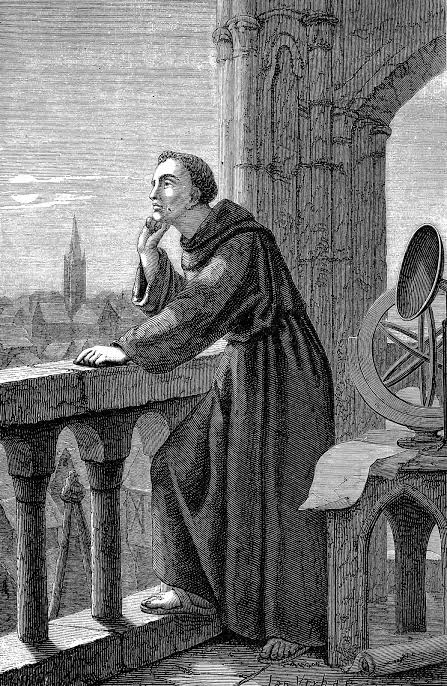


He seriously studied the problem of flying in a machine with flapping wings. He was also the first person in the West to give exact directions for making gunpowder.

Roger Bacon's work was talked about everywhere, and eventually won him a place in popular literature as a kind of wonder worker. He was also called Docotor Mirabilis- "mirabilis' in Latin

means 'wonderful teacher.'

Popular posts from this blog

Why is Pythagoras considered one of the greatest scientists of all time?

Pythagoras was an Ancient Greek mathematician and philosopher who lived more than 500 years before Christ. He spent most of his life in the Greek colonies in Sicily and southern Italy. He was also a philosopher, and founder of the religious movement called Pythagoreanism. Pythagoras had a group of disciples who followed him around, and taught other people what he had taught them. He made crucial contributions to modern philosophy, as well as mathematics, science, and religious mysticism. It is also believed that he had a significant influence on medicine, music, astronomy, and divination. Pythagoras is best known for the mathematical theory named after him. He is without doubt, one of the greatest scientists not only of the ancient world, but of all time.

Why is Alhazen known as the pioneer of modern optics?

Born in the tenth century AD, Alhazen was an Arab who was known as the first true scientist. He developed the scientific method of experimentation, and was the first person to formulate hypothesis and conduct verifiable experiments. A scientist, philosopher, astronomer, and mathematician, Alhazen wrote over a hundred books, more than half of which have been preserved. One of his most influential writings was in the field of optics. In this book Alhazen gave experimental proof of the nature of light, the structure of the eye and the basic principles of reflection via mirror. He stated that contrary to popular belief, the eye does not send out rays to the object it sees. Rather it is the light reflected via the object that the eye beholds. This was a completely new and revolutionary concept. The book comprises sevenvoles, and was translated into Latin.

Why are Galen's contributions to medicine important?

Galen was a Greek who became the Ancient Roman Empire's greatest physician. He had great expertise in anatomy, surgery, pharmacology and therapeutic methods. Galen had an absolute belief in the power of experiment and observation. He did not believe in merely following what books told him was true. He needed to verify the truth for himself His anatomical reports, based mainly on dissection of monkeys, remained uncontested until 1543, when printed descriptions and illustrations of human dissections were published. Galen, the great scientist, consolidated the work of previous Greek medical researchers, adding the results of his own research, to create an incredibly long-lasting medical doctrine. This medical doctrine dominated the Western world for 1500 years.